ጥቁር በተግባር / Black in Practice: Ethiopian Mythology and the Work of Black Solidarity
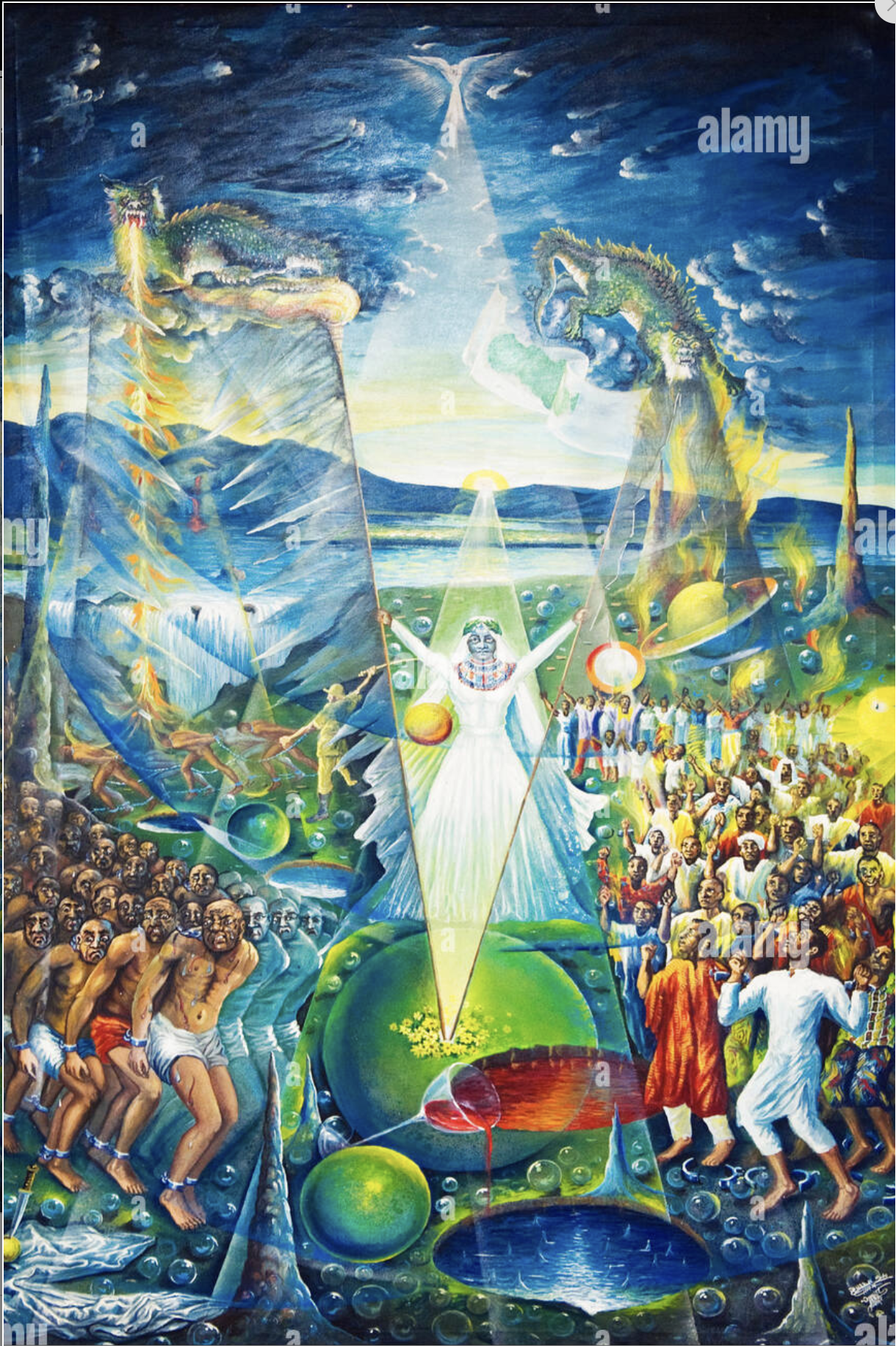
Daniel Twafe’s Three Faces of Africa
In 1957, four African high school students were invited to New York to participate in a televised discussion on racial prejudice, titled Roots of Prejudice: Who’s Responsible? The episode was part of The World We Want, a youth-focused show produced by National Educational Television (a precursor to PBS) in collaboration with the New York Herald Tribune. The episode began with each of the four students—representing the Gold Coast, the Union of South Africa, Ethiopia, and Nigeria—speaking frankly about what they understood to be the prejudices of the American people, as well as their own prejudices. When it was the young man from Ethiopia’s turn to speak, he prefaced his remarks by saying, “Well, if I say anything, I’m going to confuse you still more,” before declaring, “As an Ethiopian, I am prejudiced against both white people and Negroes.”
As one might expect, this statement was met with confusion by the other students and the moderator. Later in the discussion, the Ethiopian delegate, Mesfin Binega, expounds on this unique racial ontology by unraveling the logic of his thinking. He explains that Ethiopians are one of the lost tribes of Israel, that they had previously ruled over huge swaths of Africa and that despite their “burnt face” appearance, Ethiopians are not Negroes.
These stories, and the larger mythology of Ethiopian exceptionalism they represent, are expansive. I want to emphasize here that by mythology I do not mean a system of fabrication. Rather, I am referring to the ideas, stories, theories, and frameworks that form the cartography of the average Ethiopian’s imagination and that guide their historical self-understanding and contemporary politics.
As demonstrated by Mesfin, this mythology of exceptionalism is both useful and treacherous. It is useful because it provides a psychic cocoon that protects against the forces of white supremacist hegemony. Yet it is treacherous for precisely the same reason. By positioning Ethiopia as exceptional – and therefore adjacent to, rather than within, Blackness – it has hindered Ethiopians from adopting a genuine pan-Africanist identity and from cultivating a radical, liberatory political orientation grounded in Black solidarity.
Ethiopia as Anomaly
“Ethiopia has been perceived as being both the anomaly and the paradox of African history.”
— Teshale Tibebu, Ethiopia: The ‘Anomaly’ and ‘Paradox’ of Africa
Cedric Robinson’s Forgeries of Memory and Meaning traces how art actively participates in the formation of the American racial regime. Rather than treating culture as a secondary reflection of political life, Robinson insists that art is one of the primary sites through which racial meaning is produced, stabilized, and circulated.
It is within this framework that Teshale Tibebu’s description of Ethiopia as an “anomaly” and a “paradox” comes into focus. To describe Ethiopia in these terms is to acknowledge that the existence of an African nation whose inhabitants fit the phenotypical requirements of Blackness, and yet who nonetheless defeated a white European colonial power, poses a direct challenge to the foundational logic of Western racial regimes and white supremacist hegemony.
Ethiopia, as anomaly and paradox, constitutes such a fugitive element, one that exceeds the classification of the racial regime and threatens its coherence.
Daniel Twafe’s Three Faces of Africa
It is precisely within this terrain of fugitive meaning that Daniel Twafe’s Three Faces of Africa emerges.
Twafe’s vibrant composition is an enigmatic, visual cacophony. It is enigmatic because despite having stumbled upon it several years ago, I still know very little about the painting or its painter. A 2011 article references the piece as “Three Phases of Africa” and erroneously dates the work to be from 1908. Other sources spell the artist’s last name as “Touafe” or “Tohafe.” This elusiveness characterizes most of my experience with Ethiopian history and culture. It refuses to be grasped and made tangible. It exists supersensibly and manifests itself through unspoken feeling, owing to what Daniel Levine argues is the cult of ambiguity which forms the bedrock of Ethiopian culture.
Daniel’s last name, ጧፌ (Twafe), is unique even for Ethiopian standards. A ጧፍ (Twaf) is a traditional candle-like instrument made from braided cotton and beeswax that is used in the Ethiopian Orthodox Church. Daniel Twafe’s last name directly translates to “my twaf” or “my candle.” This is a fitting title for a man who is shrouded in mystery but whose work, I argue, illuminates and enlightens.
At the center of the composition is a humanlike figure dressed in a long-sleeved white gown with embroidery along the neckline and a veil over their head, held in place by a green clasp. The dark blue color of the figure’s face matches the sea, mountains, and sky behind and above them. This connects the figure to the landscape while separating them from the other human characters in the painting.
The painting is composed of two sets of human figures. The figures on the left all appear shackled by their hands and feet… On the right hand side, the figures are dressed in fine, varied garments… These two different sides, bending toward the center, can be understood as part of a single cycle. Those who are unchained phase into being chained, and the chained and captured become the unchained.
Daniel Twafe does a great deal of work by choosing to represent the relationship between free persons and enslaved persons as intertwined. In doing so, he explicitly rejects the notion that there can be a permanently colonized and a permanently non-colonized people.
To further accentuate this theme, Twafe evokes imagery from the Ethiopian Orthodox Canon… Between the two different groups of people sit two pools of shimmering liquid, one red and the other blue… This detail evokes the eternal cycle of torment uniquely described in the Ethiopian Orthodox Church canon’s depictions of hell.
The only figure untouched by the fire is the one at the center. This central figure stands at the intersection of three distinct lights… The figure wields two long rods, one in each hand: a blazing torch in one, and a flag bearing the image of the African continent in the other.
In my research, I came across a video by a man named Andrew Laurence… One of the works briefly discussed is Three Faces of Africa. Andrew looks at the painting and describes it as representing (from left to right) the past, present, and future of Africa. Daniel Twafe, an elderly man at this point, gently corrects him: the past is on the left, the present on the right, and the future in the center.
Three Faces of Africa stages precisely the kind of intervention Cedric Robinson describes. Rather than accepting Ethiopia’s position as an “anomaly” or “paradox” within African history, Twafe dissolves that distinction altogether. To him, Ethiopia does not stand apart from Africa in this painting; it is bound to it and its cycles of domination and liberation.
By illustrating freedom and captivity as intertwined conditions, Twafe refuses the racial regime’s need for stable categories and permanent exceptions. The painting itself operates as a fugitive element, one that diminishes the logic of the racial regime and exposes its incoherence.
Twafe insists that Africa’s past, present, and future cannot be disentangled from Ethiopia’s own. In doing so, he rejects the mythology of exceptionalism and instead affirms a shared African condition, one marked by a struggle for collective, holistic liberation, and, most importantly, the persistent possibility of emergence into something new.